Aaron Falk
The DryAaron Falk is a Melbourne police officer whose return to Kiewarra turns an old, shared lie into a present obligation. Summoned to Luke Hadler’s funeral by Luke’s father, Gerry, Falk arrives carrying not only the weight of a childhood friendship but also the knowledge that he and Luke once gave a false account connected to Ellie Deacon’s death. His investigation of the Hadler family killings gradually brings that concealed past into view, while forcing him to recognize how the town’s secrecy left Ellie vulnerable and nearly erased her from memory.
Identity and Return
Falk is thirty-six, pale from birth, with close-cropped white-blond hair and nearly invisible eyelashes. The Australian sun, which he could more easily ignore in Melbourne’s tall shadows, is difficult to escape in Kiewarra, where shade is scarce. On the day of Luke’s funeral, he drives from Melbourne for more than six hours after delaying the journey, then pauses in his car to scan the crowd before getting out. Even the practical decision to take his stiff brown canvas hat from the back seat reflects the unease of arriving in a place where his appearance and history make him conspicuous.
At the church, a local farmer mistakes him for a television journalist. Falk identifies himself as police in Melbourne, but does not join the farmer’s argument about government policy, drought, and the pressures facing people who work the land. His silence leaves him outside the public debate over blame for the Hadler deaths. Instead, his attention shifts to the family pew, where Gerry stares at him across the three coffins containing Luke, Karen, and Billy. Gerry’s letter, which had reached Falk two days earlier, makes the purpose of the summons plain: Luke had lied, Falk had lied, and Falk was expected to attend the funeral. Gerry nods; Falk looks away first. His return begins as an encounter with grief, but the withheld truth is already present between them.
The Old Alibi and Its Cost
Falk’s history with Luke is defined by loyalty that became concealment. Gretchen Schoner tells Falk that Luke had stood by him after Ellie’s death, despite pressure from people in Kiewarra to change his story and implicate Falk. In her account, Luke endured the town’s hostility rather than give him up. Her words expose the imbalance in their shared secret: Luke’s protection helped Falk escape the consequences of suspicion, while Luke remained in the place where the accusation and resentment continued to circulate.
Falk eventually acknowledges the lie to Greg Raco. When Raco asks directly whether he had anything to do with Ellie’s death, Falk says no, but admits that he was not with Luke when it happened, contrary to the account they had given. This admission does not establish what happened to Ellie or settle responsibility for her death. It does, however, break through the version of the past Falk had allowed to stand. His confession gives Raco a more truthful basis for understanding the old case, while making clear that Falk’s loyalty to Luke had involved withholding information rather than simply preserving a friendship.
The secret continues to alter how Falk interprets evidence in the present. After Gerry tells him that Luke had once been followed by a white truck, Falk considers why nobody reported seeing Luke near the river twenty years earlier. He asks who would have benefited from keeping that sighting secret, then reverses the question: perhaps Luke had seen the driver, and perhaps Luke was protecting someone else. The possibility unsettles Falk because it recasts Luke’s silence as more than a sacrifice made for him. The old lie may have concealed a wider network of secrets, and Luke may have carried another person’s burden as well.
Investigating the Hadler Case
Falk is initially reluctant to take up the Hadler investigation. When Barb Hadler asks him to find out what really happened and clear Luke’s name for Karen, Billy, and Charlotte, he expresses sympathy but says he is not the right person and that concerns should go to the police. His refusal sits uneasily beside his emotional connection to Luke, whom he tells Barb had been like a brother. The request nonetheless establishes the personal stakes of the inquiry: it is not only a question of identifying what happened, but of what will be remembered about Luke and his family.
As he works with Raco, Falk moves from scattered suspicions toward a different understanding of the case. At one point he sits on his bed with a dozen sheets of notes, drawing connections until they form a tangled web of dead ends. Rather than disguising the uncertainty, he calls Raco late and raises a new possibility: that Ellie had been abused by her father, Mal Deacon. The suggestion links the present investigation back to the town’s older failures and puts Falk’s own history with Ellie under renewed scrutiny. It is a hypothesis he voices to his investigative partner, not a conclusion that the evidence presented here establishes on its own.
A small object found in a borrowed book sharpens the investigation’s view of Karen. Falk discovers a library receipt being used as a bookmark in a crime novel. It records that Karen borrowed the book on February 19, four days before she was killed, and she had written on its reverse. The discovery first reaches him through the ordinary detail of a library loan and her use of a slip of paper to mark her place; then he notices her handwriting and handles the receipt more carefully. The object makes Karen present not only as a victim in a case file but as a reader whose book was interrupted by her death. Falk’s response registers how evidence can restore an individual life even while it raises new questions.
Relationships and Responsibility
Falk’s bond with Luke persists through absence, grief, and the consequences of their false alibi. Gerry’s direct summons makes Falk answer to the family that remained in Kiewarra, while Barb later asks him to help clear Luke’s name. After Falk is injured in the confrontation with Scott Whitlam, the Hadlers care for him as he recovers. Gerry and Barb insist that he spend time with Charlotte and tell her that he helped her father, presenting Falk’s work as a way of restoring Luke’s identity as a loving husband and father. Luke is still gone, but the family can look people in the eye again; fresh flowers gather around his grave. Falk’s involvement has not undone the loss, but it has changed what his survivors can publicly believe and say about him.
His relationship with Gretchen is shaped by the same history. She both recalls Luke’s loyalty and recognizes the lasting strain of Kiewarra’s judgment of Falk. When Falk tells her that Mal had confronted him at the cemetery, Gretchen warns him not to let Mal’s accusations control him and notes that Mal has continued to blame Falk for Ellie’s death. Her account gives Falk another view of how the past has endured in the town: old suspicions have not simply vanished with time, and Luke’s refusal to recant had consequences for those left behind. Falk’s closeness to these people draws him back into the community, but it cannot be separated from his earlier failure to speak plainly.
Change and Narrative Significance
By the end of the investigation, Falk’s role has shifted from a reluctant visitor to someone whose actions help the Hadlers recover a less distorted account of Luke. He is discharged from hospital into their care, and they credit him with bringing back the memory of Luke as a good man and loving husband. The gratitude does not absolve Falk of the earlier lie; rather, it places his present efforts beside the harm his old silence helped perpetuate.
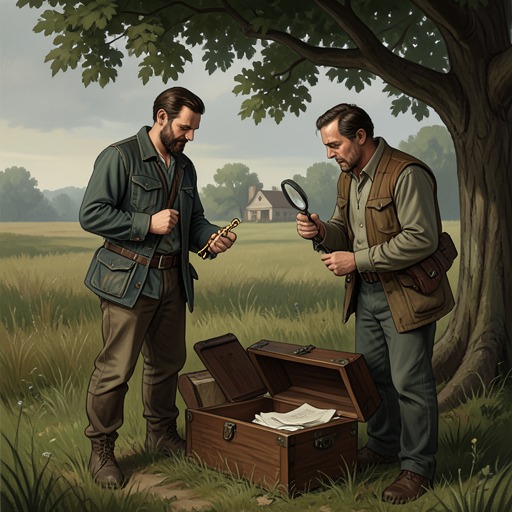
His final act at the rock tree makes that distinction explicit. After reading Ellie’s words in her recovered diary, Falk sits for a long time looking out over the empty river. He closes the diary, returns it to the backpack with the other possessions, and carries the bag back toward Kiewarra after night has fallen. Later, he walks to the place he knows Ellie loved and carves her initials, E. L. L., into a concealed crevice in the rock. He reflects that Ellie had been a victim of the town’s secrets, lies, and fear; she had needed someone, perhaps him, and he had failed her. He also thinks of Karen and Billy, who might likewise be forgotten amid the turmoil. Remembering Ellie becomes an action rather than an inward regret: he gives her name a place in the landscape, while the river remains dry and the hoped-for end of the drought is still uncertain. Falk’s arc therefore turns on the difference between protecting someone through silence and honoring the dead by refusing to let their suffering disappear.